Generative Engine Optimization for Dentists
Dental GEO Strategy at a Glance
- Dental-Focused GEO Strategy:
- We optimize your dental site for how patients ask questions—and how AI platforms (ChatGPT, Gemini, Perplexity) choose which dentists to recommend.
- Authority & Local Trust Signals:
- GEO strengthens what AI looks for most: procedure depth, credentials, consistent NAP, strong reviews, and clear local relevance.
- Structured for AI Answers:
- We use FAQs, content hubs, and schema so AI can easily interpret, summarize, and cite your pages.
- Higher-Intent Discovery:
- GEO helps your practice show up in AI-generated recommendations, reaching patients earlier and building trust before they compare options.
Generative engine optimization is reshaping how patients discover dentists by influencing which practices appear in AI-generated answers on several platforms. Instead of relying solely on Google rankings, dental practices now need content that AI systems can understand, trust, and cite. GEO focuses on building authority, improving structure, and strengthening local signals so your practice becomes the preferred recommendation in AI-driven search. Rosemont Media is a digital marketing firm that integrates GEO strategies into dental campaigns, helping practices stay visible and competitive in the new era of AI-driven search.
Generative engine optimization (GEO) is the next evolution of digital marketing for dentists, shaping how practices appear not just in traditional Google results, but in AI-generated answers on platforms like ChatGPT, Gemini, Claude, and Perplexity. As more patients turn to conversational search to ask questions about dental symptoms, treatments, and local providers, generative engines increasingly influence which practices they trust and choose. This page breaks down how GEO works, why it matters, and what dentists can do to ensure their websites are recognized as authoritative, accurate, and locally relevant. With the right strategy, your practice can become a top recommendation in the rapidly growing world of AI-powered search.

What Is Generative Engine Optimization (GEO)?
Generative engine optimization is an emerging discipline focused on improving how your dental practice can appear, not just on traditional search engines, but within the fast-growing ecosystem of generative AI platforms. As models like ChatGPT, Google Gemini, Claude, SearchGPT, and Perplexity become central to how people find information online, dental practices must adapt their digital strategies. GEO goes beyond keyword rankings and dives into how AI systems understand, interpret, and recommend your expertise. When patients ask an AI assistant questions like “Who is the best dentist near me?” or “How much does Invisalign® cost?”, generative engines may respond with synthesized, conversational answers that highlight specific practices. Optimizing for those moments of influence is the core of GEO.
GEO requires creating content that AI models can easily parse, trust, and reuse. These platforms analyze patterns across vast datasets, pulling from both public information and your own online footprint. If your website is rich with authoritative dental content, clear explanations, structured information, and consistent branding signals, generative engines are more likely to reference you when producing answers. For dentists, this represents a major opportunity: instead of competing only for blue links on Google, you can position your practice to be directly recommended inside AI-generated responses.
The Shift from Traditional Search to Generative AI
Search behavior is fundamentally changing. Patients are no longer relying solely on Google queries that lead them to a list of website links. Instead, they increasingly ask AI models complex, conversational questions—“What’s the best treatment for gum recession?” or “Which dentist in my area does same-day crowns?”—and receive immediate, consolidated answers. AI platforms act as “answer engines,” skipping the step where users browse multiple websites. This means patients may form impressions or make decisions before ever visiting your homepage.
Generative platforms also provide context-rich recommendations. If an AI assistant identifies your practice as credible and relevant, it may include your name, services, or location directly within its response. For dentists, that exposure can be extremely valuable, especially since many users trust AI summaries for convenience and clarity. As the shift continues, practices that optimize for generative discovery can have a clear advantage in capturing patient attention early.
How Generative Engines Work
Generative engines rely on Large Language Models (LLMs), retrieval mechanisms, and synthesis pipelines. At a high level:
- LLMs (like GPT or Claude) are trained on billions of data points to understand language, dentistry terminology, patient questions, and real-world context.
- Retrieval systems scan external sources, including your website, business listings, reviews, and structured data, to verify facts and pull in high-quality information.
- Answer synthesis blends learned knowledge with retrieved content to generate a personalized, conversational response.
Due to this structure, the quality of your online information directly influences how these systems perceive your expertise. Well-organized dental content, such as clear procedure pages, FAQ-style explanations, schema markup, consistent NAP information, and medically accurate details, helps generative engines recognize your authority. If your content is thin, outdated, or technically inaccessible, AI may skip over your practice in favor of competitors with stronger digital signals.
For more on LLMs, read our blog post, “What are the Most Commonly Used AI LLMs When Looking For A Dentist?”
Why GEO Matters Specifically for Dentists
Dentistry is one of the most competitive local service industries, especially in metro regions where patients have dozens of options. GEO gives dentists a new way to stand out by shaping how AI evaluates and recommends local practices. As generative platforms increasingly guide decision-making, appearing in these AI-driven responses becomes a key differentiator.
Patient trust is another critical factor. Oral health questions often involve medical risk, cost concerns, and fear of misinformation. AI models tend to prioritize dental practices with credible, accurate, and professionally written content. If your site demonstrates expertise, through detailed procedure pages, before-and-after content, biographies, or patient education resources, AI is more likely to see your practice as a reliable source.
Finally, generative engines use a mix of online signals to determine which dentist to reference in a response. Your digital footprint, including authority content, consistent local listings, high-quality reviews, and brand clarity, helps AI systems understand who you are, what you offer, and why you should be recommended. GEO ensures those signals are clear, organized, and optimized so your practice becomes the preferred choice in AI-driven recommendations.

How Generative Engine Optimization Differs from Traditional SEO
GEO builds on the foundations of search engine optimization (SEO) but adapts them to the radically different way AI systems interpret and deliver information. While traditional SEO focuses on ranking in Google’s list of links, GEO is about influencing how AI models pull information, evaluate authority, and present answers directly to users. For dentists, understanding the differences is essential, because patients are increasingly bypassing search result pages in favor of direct, AI-generated responses.
Traditional SEO (Google Search) vs. GEO (AI Answers)
Traditional SEO is built around helping Google understand your website’s relevance through signals like keywords, meta tags, backlinks, site speed, and structured data. The goal is to appear prominently in search results so users click through to your website. In contrast, GEO focuses on how AI engines use your content, not just how they rank it. Generative AI models provide complete answers without requiring the user to visit a webpage. Their “rankings” are not presented as lists but as synthesized statements, explanations, or recommendations.
In SEO, visibility means being on page one. In GEO, visibility means being included as part of the AI’s answer—mentioned as a trusted resource, cited for factual information, or recommended as a top dentist. This fundamentally shifts the optimization goal from ranking for queries to influencing how AI interprets complexity, context, and credibility.
Where the Two Strategies Overlap
Despite their differences, SEO and GEO share several foundational elements. Both strategies reward high-quality content, strong site architecture, fast loading speeds, and consistent practice information across the web (NAP data). Both also rely on authority signals such as positive reviews, reputable backlinks, and well-written educational pages that demonstrate expertise.
In practice, GEO builds on these SEO fundamentals but demands a deeper level of clarity and structure. The more accurate, organized, and consistent your online information is, the more likely both Google and AI engines are to trust and use it. Good SEO supports GEO—and modern digital strategies require both.
What GEO Requires That SEO Doesn’t
GEO introduces new requirements that go beyond traditional SEO best practices:
- Data-rich content: AI models perform best when they can pull specific, factual information. Detailed procedure descriptions, cost ranges, recovery timelines, and candidacy criteria help generative engines craft more useful answers—and choose your practice as the source.
- Clear expertise signals: LLMs prioritize authoritative voices. Dentists must highlight credentials, continuing education, certifications, years of experience, and clinical explanations in a way AI can easily interpret.
- More citations and factual framing: Unlike Google, which evaluates pages using a link-based system, AI engines rely heavily on explicit, well-structured facts. Content should read like a trusted reference—rich with definitions, steps, benefits, risks, and evidence-based details.
Together, these elements make GEO a more precision-oriented discipline, designed to help AI models understand why your practice is the best answer.
How Patients Use Generative AI to Find Dentists
Generative AI has quickly become a trusted resource for patients seeking dental information, treatment recommendations, and provider options. Instead of browsing multiple websites, patients now ask conversational questions to AI platforms and receive clear answers in seconds. This shift has transformed how people evaluate symptoms, compare treatments, and ultimately choose a dentist. For dental practices, understanding this new behavior is essential for maintaining visibility in an increasingly AI-driven search ecosystem.
Common Dental Queries in Generative Search
Patients frequently turn to AI assistants with questions that replicate real-world conversations they would typically have with a dentist or front office team. Some common generative search queries include:
- “Do I need a root canal or can the tooth be saved another way?”
- “Who is the best cosmetic dentist near me?”
- “How much does Invisalign® cost in my area?”
- “What is the difference between dental implants and dentures?”
- “Which dentist offers sedation dentistry for anxious patients?”
Generative engines excel at providing direct, patient-friendly explanations to these questions, often pulling from multiple high-authority sources. If your practice is represented well online, with detailed procedure pages, FAQs, and accurate business information, AI models are more likely to reference your content or recommend your office directly.
AI Assistants as “Digital Concierges”
Generative AI tools now act as personal digital concierges, guiding patients through the discovery and decision-making process. These assistants don’t just answer medical questions—they refine options, compare providers, and tailor recommendations to user intent.
For example, an AI assistant may say:
“Dr. Smith in downtown San Diego is known for cosmetic dentistry and offers same-day crowns.”
This type of personalized curation bypasses traditional search results and can significantly influence which practices patients consider. As these tools become integrated into smartphones, search platforms, and voice assistants, patient reliance on generative recommendations will only increase.
Implications for Local Dental Practice Visibility
Since generative engines often produce a single direct answer rather than a list of links, visibility becomes more competitive. Only a handful of dentists in any region may be mentioned—or none at all if AI cannot confidently identify a qualified provider. This makes GEO essential for ensuring your digital footprint is strong, accurate, and rich in expertise.
For dental practices, this means:
- Your online information must be complete, consistent, and highly authoritative.
- AI-friendly content structures (FAQs, definitions, detailed procedure explanations) are critical.
- Practices with clearer expertise signals are more likely to appear in AI-generated recommendations.
Ultimately, the rise of generative search changes how patients choose providers and GEO ensures your practice isn’t left out of the conversation.

Key Ranking Factors in Generative Engine Optimization
GEO focuses on strengthening the signals that AI platforms use to understand, trust, and reference your dental practice in their answers. While traditional search engines rely on crawlable content, backlinks, and technical optimization, generative engines interpret information differently. They prioritize clarity, authority, factual grounding, and contextual relevance, especially in medical fields like dentistry. To increase your chances of being included or recommended in AI-generated responses, your website must present information in formats that LLMs can easily parse and verify.
Below are the primary ranking factors that influence how generative engines evaluate your practice.
-
Topical Authority and Depth of Expertise
Generative engines place a high value on topical authority, especially in healthcare. AI models are trained to avoid misinformation and prioritize content that demonstrates clinical understanding. For dentists, this means your website must clearly show depth of knowledge across relevant topics—not just superficial descriptions.
Dentistry-specific authority signals include:
- Comprehensive procedure pages (e.g., implants, crowns, veneers, Invisalign®)
- Condition-focused pages (e.g., gum disease, TMJ issues, tooth pain)
- Clear explanations of risks, benefits, alternatives, and candidacy
- Evidence-based terminology that aligns with modern clinical standards
Medically accurate language is essential. AI models compare your content against vast datasets of medical information. If your explanations are vague, commercially biased, or overly simplified, generative engines may judge them as less authoritative. Detailed, precise descriptions rooted in real clinical expertise help LLMs classify your practice as a trustworthy source.
-
Trust Signals and Source Credibility
To minimize the risk of recommending unqualified providers, generative engines evaluate credibility markers that demonstrate professional legitimacy. These signals align closely with Google’s E-E-A-T framework (Experience, Expertise, Authoritativeness, and Trustworthiness), but GEO places even more emphasis on explicit proof of expertise.
Key trust signals include:
- Robust author bios that list credentials, training, areas of focus, and years of experience
- Board certification and membership in professional associations (ADA, AACD, AGD, AAOMS, etc.)
- Citations or references when describing medical facts or clinical guidelines
- Consistent NAP data (name, address, phone) across all platforms
In many cases, generative engines will only reference a dentist if the site clearly displays who wrote the information and why they are qualified to discuss it. For medical content, anonymity reduces trust; transparency increases it.
-
Structured Content and Data Formatting
Generative engines rely on patterns. They scan text for recognizable formats that help them extract and reuse information cleanly. Well-structured content is significantly more likely to be quoted or summarized by AI systems.
Effective GEO-friendly formatting includes:
- FAQs: Breakdown common patient questions with short, direct answers.
- Tables: Compare treatments, outline cost ranges, or summarize recovery timelines.
- Step-by-step sections: Useful for describing procedures, appointment processes, or insurance workflows.
- Bullet lists: AI models easily parse lists for key points and factual snippets.
- Schema markup: Adds machine-readable context, especially for FAQs, reviews, and local business data.
The more structure you give your content, the easier it becomes for AI to detect meaning, categorize pages, and incorporate your information into its responses.
-
Clear, Fact-Based, & Citation-Friendly Writing
Generative engines prefer content that can be cleanly lifted and reused within their own synthesized answers. This requires writing that is:
- Fact-driven: Provide specifics—timeframes, benefits, contraindications, etc.
- Precise: Avoid vague language; use clinically correct terminology.
- Neutral in tone: AI models favor objective explanations, not sales-driven messaging.
- Easily quotable: Short, well-written paragraphs increase the odds of being referenced verbatim.
Consider writing with the expectation that your content should function as a “source text” for AI explanations. When information is presented clearly and backed by evidence, AI systems are more likely to pull it into their responses exactly as written.
-
Local Relevance in GEO
For queries like “best dentist near me” or “Invisalign® in Austin,” generative engines prioritize local context. They evaluate not only expertise but geographic relevance. This means your website must contain clear signals about where your practice is located and which communities you serve.
Important GEO local signals include:
- Geographic cues: City names, neighborhoods, local landmarks, and service areas written naturally into content.
- Proximity indicators: Embedding your full address consistently across your site and directories.
- Location-based keywords: “Cosmetic dentist in Denver,” “dental implants in Scottsdale,” etc.
- Localized FAQs: “How much do implants cost in Tampa?”
AI models connect these cues to generate accurate local recommendations. If your geographic signals are unclear or inconsistent, generative engines may ignore your practice entirely, even if your clinical expertise is strong.
Content Strategies for GEO: How Dentists Can Rank in AI Answers
GEO requires a different approach to content creation than traditional dental SEO. Instead of writing solely to improve rankings on Google, dentists must now create content that generative engines can easily interpret and integrate in their responses. Since AI systems prioritize clarity, authority, structure, and factual precision, your website must become a resource that LLMs view as both trustworthy and richly informative. The following strategies outline how dentists can create GEO-ready content that increases the likelihood of being cited, recommended, or referenced in AI-generated answers.
Create GEO-Ready Content Hubs
Generative engines favor websites that demonstrate deep topical authority, and the most effective way to build that authority is through structured content hubs. These hubs organize related pages in a way that mirrors how patients and AI systems think about dentistry.
Procedure-Based Content Hubs
Each major service you offer should have its own comprehensive content hub or page. This includes procedures such as:
- Dental implants
- Invisalign® and clear aligner therapy
- Porcelain veneers
- Same-day crowns
- Root canal therapy
- Wisdom tooth extraction
Within each hub, include detailed subpages discussing candidacy, benefits, risks, alternatives, costs, recovery timelines, and FAQs. AI systems prefer deep networks of interconnected information because it shows mastery of a topic.
Condition-Based Content Hubs
Patients often search based on symptoms rather than procedures. Generative engines frequently receive queries like “Why does my tooth hurt when I bite down?” or “How do I treat gum disease?” Creating hubs around common dental conditions helps AI models understand the full context of these issues.
Condition-based hubs may include:
- Gum disease and periodontal treatments
- TMJ/TMD
- Tooth sensitivity
- Cracked or fractured tooth
- Abscesses and infections
These can show AI that your practice is not only procedural but clinically knowledgeable—an important factor when models choose which dental source to cite.
Prioritize Patient Question Content
AI models heavily weigh content that directly answers questions. As generative engines are built around natural language processing, they seek out content written in the same question-and-answer style that users prefer.
This means dentists should create comprehensive Q&A sections that address:
- Symptoms
- Treatment options
- Costs
- Recovery
- Insurance considerations
- Risks and complications
How to Structure GEO-Friendly Questions
- Phrase questions the way patients actually speak:
- “Is Invisalign® painful?”
- “Do dental implants last forever?”
- “How long does it take to recover from wisdom tooth removal?”
- Provide short, direct answers first, followed by deeper context.
- Break long explanations into simple paragraphs or bullet lists.
- Include multiple variations of the same question to mirror real search phrasing.
When AI systems look for responses to user queries, they gravitate toward clearly labeled Q&As. These sections often get reused verbatim by generative models, making this one of the strongest content strategies in GEO.
Implement AI-Friendly Formatting
The format of your content is almost as important as its quality. Generative engines prefer structured, scannable layouts that make it easier to identify key facts. Incorporating AI-friendly formatting can help your practice become a top pick when models generate their answers.
Lists
Bullet and numbered lists allow AI to extract concise insights. Use them to summarize benefits, steps, risks, or comparisons.
Definitions
Short, bolded definitions help LLMs capture essential explanations. For example:
- Dental implant: A titanium post that replaces the root of a missing tooth.
- Occlusal trauma: Injury caused by excessive biting forces.
These definitions help improve content parsing and increase the chance your site becomes a reference source.
Step-by-Step Explanations
Generative engines often respond with procedural walk-throughs. Supplying your own step-by-step sections helps AI choose your practice as the authority.
For example:
Steps in the Dental Implant Process
- Consultation and imaging
- Bone grafting (if necessary)
- Implant placement
- Healing and osseointegration
- Abutment and final crown placement
AI models recognize this format instantly and may reuse it when patients ask, “How do dental implants work?”
Add Example-Based Content
AI models favor real-world examples because they add clarity, context, and narrative depth to clinical explanations. Incorporating example-based content gives generative engines more material to work with.
Before-and-After Scenarios
Write descriptive narratives about typical cosmetic or restorative transformations, even if patient names are not used. Example:
“A patient with significant enamel wear received four porcelain veneers to restore shape and symmetry.”
This helps AI communicate the value of treatment more effectively.
Patient Case Studies
Case study pages that outline diagnosis, treatment planning, and outcomes are particularly influential. They demonstrate hands-on expertise and clinical reasoning.
FAQ Expansions
Expand your FAQ sections by adding variations of questions, situational examples, and troubleshooting insights. AI engines typically gravitate toward these hyper-specific answers because they mirror how people ask detailed follow-up questions.
Optimize for Long-Form Context
Short web pages no longer perform well in generative search. AI thrives on context and it needs depth to confidently classify information and recommend a dentist.
Long-form content matters because:
- AI models prefer information-dense pages. The more detail you provide, the easier it is for models to extract accurate answers.
- Context helps avoid misinformation. LLMs down-rank shallow content because it creates more risk.
- Long-form content builds trust. Generative engines view comprehensive pages as “expert-level” sources.
To optimize for context:
- Write 1,000–2,000 words for major procedure pages.
- Include background, symptoms, steps, risks, costs, candidacy, and recovery.
- Link to supporting subpages (e.g., implant types, sedation options).
- Add diagrams, glossaries, or comparison tables when relevant.
Richer pages not only perform better in GEO but can also enhance SEO and patient education simultaneously.
Local GEO for Dentists: Getting Recommended in Local AI Searches
Local visibility has always been essential for dental practices, but the shift toward generative AI has introduced a new layer of competition. Instead of showing several local map results, as seen in Google’s Local Pack, AI platforms frequently present one primary recommendation or a short list of nearby dentists. This means that dentists must optimize not only for traditional search but also for AI-driven local discovery. Local GEO ensures that generative engines understand where your practice is located, which community you serve, and why you are the most credible local option.
AI Local Pack vs. Google Local Pack
Google’s Local Pack traditionally displays three to four local businesses related to a query, such as “dentist near me” or “best cosmetic dentist in Seattle.” These results rely on proximity, reviews, business categories, and Google Business Profile optimization.
AI Local Packs work differently. Instead of showing a map with listings, generative engines tend to:
- Produce a single recommended provider
- Generate a short list of two or three dentists
- Explain why those dentists are relevant
- Pull information from a wider range of online data sources
AI models often assess business data, website content, reviews, bios, and third-party listings before deciding which practice to recommend. This shift dramatically raises the stakes: if your practice is not among the top few options the AI finds most authoritative and locally relevant, you may not be mentioned at all.
This makes Local GEO essential for ensuring that your practice can appear in these high-value AI-generated recommendations.
How AI Evaluates Local Authority
Generative engines rely on several signals to determine whether your practice is credible and contextually relevant within your community. These signals closely resemble what traditional local SEO requires, but AI models interpret them in a more holistic way.
Address Consistency
AI systems scan your website, Google Business Profile, social channels, and directories to confirm that your address, phone number, and practice name are consistent across the web. Inconsistent or outdated information can cause AI models to question accuracy, leading to exclusion from local recommendations.
Proximity
Just like Google, generative engines weigh proximity heavily, but not exclusively. AI models look for geographic cues in your content, such as:
- City and neighborhood names
- Nearby landmarks
- Service area descriptions
The clearer your geographic signals, the more likely you are to appear in local AI results for relevant queries.
Community Involvement
AI engines also evaluate authority through brand presence. Mentions in local publications, sponsorships, charity events, and community partnerships all contribute to perceived local leadership. This type of involvement helps AI models understand not just where you are, but why you matter in your area.
Building Local Citations for AI Discovery
Local citations remain one of the strongest ranking factors for AI-driven local discovery. Citations help generative engines verify a practice’s identity, location, and legitimacy. The more accurate and widespread your presence, the easier it is for AI to trust your information.
Important citation sources include:
- Google Business Profile
- Yelp and Healthgrades
- Zocdoc and RealSelf
- Dental associations and directories (ADA, AACD, AGD, AAOMS)
- Local chamber of commerce listings
- Local news sites and community blogs
Each citation acts as a confirmation signal, reinforcing that your practice is legitimate and well-recognized in your area. Additionally, make sure your NAP data is identical across all listings. AI engines rely on this consistency to validate your business details before recommending your practice.
Reputation as a Local GEO Ranking Factor
Online reputation is one of the most influential factors in local generative search. Since AI models aim to provide trustworthy recommendations, they heavily weigh patient sentiment when evaluating dentists.
Key reputation signals include:
- Volume of reviews
- Star rating trends
- Recency of reviews
- Specificity of feedback (e.g., mentioning implants, Invisalign®, comfort level, friendliness)
Generative engines analyze review content, not just ratings, to determine what patients appreciate most about your practice. When reviews consistently highlight your expertise, technology, bedside manner, or outcomes, AI is more likely to recommend your office.
In addition, AI-generated summaries often reference reputation directly:
“Dr. Smith is highly rated for cosmetic dentistry and known for her compassionate care.”
The stronger your online reputation, the more confident AI models become in citing you as a top local provider.

The Role of Online Reviews in Generative Search Visibility
In the generative search ecosystem, online reviews and overall reputation management carry even more weight than they do in traditional SEO. While Google uses reviews primarily as a local ranking and conversion factor, generative AI platforms analyze reviews to determine credibility, trustworthiness, and patient satisfaction. That information is then incorporated directly into their responses. This means your reviews don’t just influence patient perception; they can actively shape how AI models evaluate and recommend your dental practice. A strong, consistent review profile significantly increases the likelihood that generative engines will reference your practice as a top local option.
How AI Summaries Use Reviews
Generative engines scan reviews across platforms like Google, Yelp, Healthgrades, Facebook, and specialty directories to assess your practice. They do more than count stars—they extract themes and insights. These engines often include review-based commentary directly within responses, such as:
- “Patients frequently praise this dentist for gentle treatments.”
- “Highly rated for cosmetic dentistry and Invisalign®.”
- “Known for friendly staff and modern technology.”
AI-generated summaries aim to provide a helpful, human-like overview of what real patients are saying. If your reviews reflect consistency and excellence across many sources, AI systems will view your practice as reliable and worth recommending.
Sentiment and Relevance
Beyond the overall star rating, generative engines analyze:
- Sentiment: Whether reviews express positive, neutral, or negative emotions.
- Specificity: Whether patients mention treatments like implants, crowns, Invisalign®, or emergency care.
- Recency: Whether the practice is actively receiving new feedback.
- Patterns: Whether there is consistent praise or recurring concerns.
This level of analysis means that 20 detailed, recent reviews may carry more weight in generative search than 200 older or generic reviews. AI models favor relevance, clarity, and authenticity. They also cross-check sentiment with your website content to make sure what you claim aligns with real patient experiences.
Building a GEO-Friendly Review Strategy
To improve generative search visibility, dentists should cultivate a review strategy that supports both accuracy and authority.
Tips for a strong GEO-aligned review program:
- Ask consistently: Request reviews after positive patient interactions or milestone appointments.
- Diversify platforms: Encourage reviews on Google, Yelp, Facebook, Healthgrades, and dental-specific directories.
- Prioritize detail: Ask patients to mention the treatment they received and what made the experience positive.
- Respond professionally: AI models notice responsiveness, tone, and conflict resolution.
- Highlight expertise: Reviews that mention technology, sedation options, cosmetic treatments, or complex cases enhance perceived authority.
A robust, well-managed review profile can not only improve patient trust, but also directly strengthen your visibility in AI-generated recommendations. When generative engines recognize consistent praise, clear expertise, and high patient satisfaction, your practice becomes a frontrunner in local AI-driven search results.
Using AI Tools to Strengthen GEO Strategy
GEO is often most effective when supported by the right analytical and planning tools. Fortunately, dentists now have access to advanced AI-driven platforms that help identify opportunities, assess competition, and create content that aligns with generative search behavior. These tools can not only streamline GEO workflows but also enhance accuracy and strategic depth. By integrating AI into your discovery, research, and content creation processes, your practice can stay ahead of competitors and better position itself for visibility in AI-generated answers.
Tools for Keyword & Topic Discovery
Traditional keyword tools are still valuable, but GEO requires insights into how people phrase questions conversationally because those questions drive generative search. Several AI-driven platforms excel at uncovering long-tail queries, symptom-based searches, and natural-language phrasing.
Perplexity
Perplexity is one of the best tools for exploring real-world patient questions. Its “Related Questions” and conversational search features reveal precisely how users speak when seeking dental advice. This can help you build Q&A-rich content that AI models prefer.
Ahrefs
Ahrefs remains a strong resource for keyword analysis, SERP data, and topic modeling. It identifies search volume, keyword difficulty, and content gaps that still influence GEO performance, especially since AI models partially rely on indexed search content.
Google SGE (Search Generative Experience)
Google’s SGE preview allows you to see which types of dental queries trigger AI-generated results. Observing which competitors appear in these summaries offers insight into the content patterns and authority signals Google’s generative systems value most.
Combining these tools gives dentists a complete picture of both search demand and generative query intent, which is crucial for building GEO-ready content.
Using AI to Analyze Competitor GEO Strength
Generative engines often recommend only a few local dentists, so understanding your competitors’ strengths is essential. AI tools can quickly analyze competitor websites, local listings, reviews, and content structures to identify where they excel and where gaps exist.
AI-assisted competitor analysis can reveal:
- Who is currently appearing in generative summaries
- Which procedures competitors cover in greater depth
- Their review sentiment and topical authority
- Missing content areas that your practice can fill
- Schema and structural differences that boost visibility
This type of analysis helps you reverse-engineer what AI models perceive as high authority and allows you to position your practice more favorably.
AI-Assisted Content Planning and Brief Building
One of the strongest uses of AI in GEO is content planning. AI tools can generate outlines, identify subtopics, and structure article briefs in a way that mirrors how generative models expect information to appear.
AI-assisted planning can help you:
- Build long-form, context-rich procedure pages
- Create structured sections such as FAQs, definitions, and step-by-step breakdowns
- Identify the most valuable patient questions for each topic
- Standardize formatting for maximum AI readability
- Produce content frameworks that align with E-E-A-T principles
AI-generated briefs ensure that every page you write is optimized for clarity, structure, and authority—the elements most essential for generative visibility.
GEO Best Practices for Dental Websites
GEO requires a thoughtful approach to content creation—one that blends patient-centered communication with the precision and clarity AI systems need to interpret and reuse information. Since generative engines prioritize structured, accurate, and authoritative content, dentists must ensure their websites incorporate best practices that strengthen both human readability and machine comprehension. The following principles serve as a foundation for building a website that performs well across all forms of search, including AI-driven platforms.
Write for Both Humans and AI
Effective GEO content must educate patients clearly while also providing structured, machine-friendly information. This means striking the right balance between conversational explanations and high-fidelity clinical details.
To write for both humans and AI:
- Start with direct, simple explanations and follow with deeper context.
- Use patient-friendly language, but incorporate proper dental terminology where relevant.
- Keep paragraphs concise to improve scannability for readers and LLMs.
- Use clear sections, headings, lists, and definitions to signal content structure.
- Avoid overly promotional language—AI models prefer objective, factual writing.
When content addresses real patient concerns while maintaining clarity and structure, generative engines are far more likely to trust and reference it.
Maintain Medical Accuracy
Accuracy is one of the strongest ranking factors in generative search. AI systems cross-check your content against large datasets of medical information to determine whether your explanations align with established clinical standards.
To strengthen medical accuracy:
- Describe procedures with correct terminology and step-by-step clarity.
- Avoid exaggerating benefits or downplaying risks.
- Ensure cost ranges, healing timelines, and candidacy criteria are medically appropriate.
- Reference evidence-based concepts where applicable.
- Include biographies or author attributions that demonstrate clinical expertise.
Generative engines are designed to avoid misinformation, particularly in healthcare. If your content is vague, outdated, or inconsistent with modern standards, AI will favor other dental websites with stronger clinical clarity.
Use Scannable, High-Fidelity Information
AI models prefer information that is organized, structured, and easy to extract. Scannable formats can not only improve user experience but also allow generative engines to identify key facts that can be included in synthesized responses.
High-fidelity, AI-friendly formatting includes:
- Bullet lists of symptoms, benefits, risks, or treatment steps
- Short definitions embedded throughout content
- Comparison tables (e.g., veneers vs. cosmetic bonding)
- Timelines (e.g., “What to expect during the first 48 hours after tooth extraction”)
- Mini-glossaries for technical terms
These components help AI systems quickly categorize information, assign meaning, and reference your content accurately.
Keep Content Updated Regularly
Generative engines value freshness, especially in healthcare where treatment techniques, materials, and technologies evolve. Outdated content signals lower relevance, and AI systems may avoid recommending practices with stale or incomplete information.
To keep your content current:
- Update major procedure pages at least once per year.
- Refresh cost estimates and technology descriptions as they change.
- Add new FAQ sections based on emerging patient questions.
- Expand pages when new clinical evidence, tools, or materials become available.
- Ensure your practice details (hours, address, services) stay accurate.
Regular updates can reinforce credibility and help AI models maintain confidence in your practice as a timely, authoritative resource.
Case Studies: How GEO Improves Dental Practice Visibility
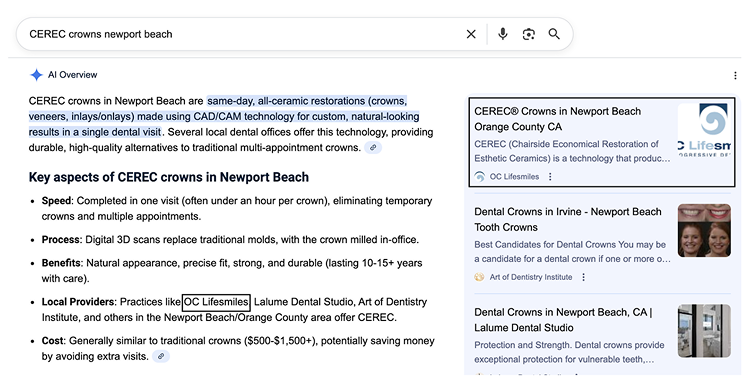
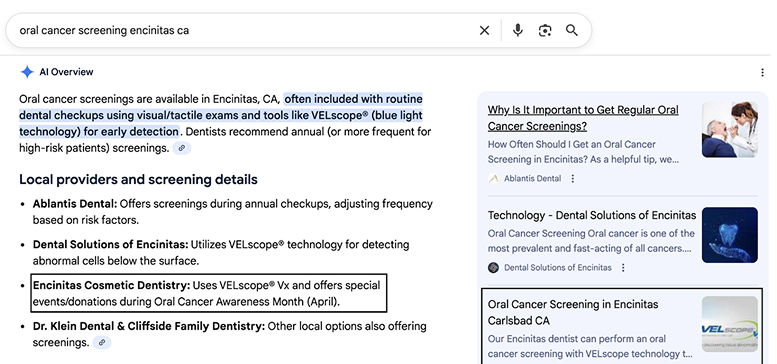
Several Rosemont Media dental clients have seen comparable success, with key pages showing up in AI-generated overviews.
Client Example
How Rosemont Media Helps Dentists Improve GEO Performance
 As generative search becomes a defining force in digital marketing, dental practices need more than traditional SEO—they need a comprehensive GEO strategy that aligns with how AI systems evaluate expertise, trust, and relevance. Rosemont Media specializes in helping dentists strengthen their visibility across all search environments, including emerging generative platforms. Through custom website development, strategic content creation, technical enhancements, and continuous optimization, Rosemont Media ensures dental practices are positioned to be recommended, trusted, and cited by the next generation of search engines.
GEO-Optimized Dental Website Development
A high-performing GEO strategy begins with a website that AI engines can understand, crawl, and confidently reference. Rosemont Media builds custom dental website designs with clean architecture, scannable layouts, and AI-friendly formatting that enhances both patient readability and machine comprehension.
Our development process includes:
- Structuring content into clear hierarchies for easier AI parsing
- Implementing fast-loading, mobile-optimized designs
- Using modern code and technical best practices for improved crawlability
- Integrating natural language patterns and question-based navigation
This ensures your website becomes a reliable source of detailed, structured information—exactly what generative engines prioritize.
Content Production and Authority Building
Rosemont Media’s team is trained specifically in creating GEO-ready dental content. We blend patient-friendly education with clinical precision, crafting comprehensive pages that demonstrate expertise across all major dental procedures and conditions.
Our content creation services include:
- Long-form procedure pages that establish strong topical authority
- Q&A sections aligned with generative AI query patterns
- GEO-optimized blogs addressing emerging patient questions
- Detailed biographies and expertise pages that strengthen E-E-A-T signals
Every piece of content is written for both humans and AI, ensuring clarity, depth, and medical accuracy. This dual-optimized approach helps generative platforms identify your practice as a trustworthy, authoritative source for patient inquiries.
Technical Enhancements and Schema Implementation
Technical optimization is critical for visibility in generative search. Rosemont Media implements advanced schema markup and structured data frameworks that help AI engines interpret your website’s purpose, services, and authority.
Our technical GEO optimizations include:
- Dentist and LocalBusiness schema
- FAQ schema to support question-based AI queries
- Procedure schema for implants, Invisalign®, veneers, and more
- Enhanced metadata and internal linking structures for improved context
- Clean, optimized code to support AI crawlability
These enhancements give AI models clearer, more reliable signals, often leading to higher accuracy when generative engines reference or recommend your practice.
Ongoing Monitoring and Optimization
GEO is not a one-time project—it evolves as AI systems update how they interpret and present information. Rosemont Media provides continuous monitoring to ensure your dental practice stays ahead of algorithm changes and new generative search behaviors.
Ongoing GEO support includes:
- Tracking emerging AI-generated search results
- Updating content to reflect new technologies, procedures, and trends
- Enhancing authority signals, reviews, and local relevance
- Regular technical audits to maintain schema and crawlability strength
This proactive approach ensures your practice remains visible, credible, and competitive in both traditional and AI-powered search landscapes.
Preparing Your Dental Practice for the Future of Search
As generative AI transforms how patients search for healthcare providers, dental practices must evolve beyond traditional SEO and embrace a comprehensive GEO strategy. GEO ensures your website communicates expertise clearly, delivers medically accurate information, and provides structured, AI-friendly content that generative engines can trust and reuse. With strong technical foundations, rich content hubs, consistent local signals, and a proactive review strategy, your practice becomes far more likely to be recommended directly within AI-generated answers.
Dentists who invest in GEO today are positioning themselves at the forefront of digital discovery—capturing patient attention earlier, building deeper trust, and standing out in increasingly competitive markets.
If you want your practice to stay visible in the age of ChatGPT, Gemini, and emerging AI-powered search tools, now is the time to act. Rosemont Media can help you build a GEO-ready digital presence that strengthens authority, improves local relevance, and ensures your practice is recommended when patients ask AI for the best dentist near them. Contact us to schedule a consultation and let’s prepare your practice for the future of search—starting today!