Best Social Media Platforms for Plastic Surgeons
Not every social media platform deserves an equal share of your practice’s time and energy — the key is matching your content to the platforms where your ideal patients are already spending time. Younger patients tend to be most active on TikTok and Instagram, while older patients often engage more on Facebook and YouTube. A focused strategy built around two or three well-chosen platforms, paired with a consistent posting cadence, can typically outperform a scattered presence across every channel every time.
Social media plays a key role in many of our social and interpersonal lives, but the ways in which some of the most popular platforms have become integral to our business needs as well can be a little surprising. According to the American Society of Plastic Surgeons (ASPS), major search engines like Google are even promoting searches based on social media presence to a greater degree than other factors, such as training, memberships, or educational background. Educational plastic surgery content has always performed well on social media and generally maintains a high level of engagement on every platform — on TikTok alone, the #PlasticSurgery hashtag receives more than 16 billion views. Not only does social media for plastic surgeons provide limitless opportunities for brand awareness, patient outreach, and cosmetic surgery education, but more and more people are also looking to social media to actually choose their plastic surgeon.
Simply being on social media isn’t enough to make a difference in your marketing metrics. To truly excel in the digital space, you need to skillfully leverage the most popular social platforms according to the online habits and demographic of their users. Keep reading to find out which social media platforms are key players in impacting the plastic surgery marketing space.
How to Choose Which Platforms to Prioritize
With so many platforms competing for your attention and your team’s time, jumping on every channel at once is one of the most common mistakes plastic surgery practices make. A half-maintained TikTok account and a neglected Facebook page can hurt your credibility more than having no presence at all. The most effective social strategies aren’t the broadest ones; they’re the ones built around an honest assessment of your practice’s size, your target patient, and your actual capacity to create content.
Start with Your Target Patient
Before you post a single piece of content, ask yourself: who is most likely to book a consultation with my practice? This question should drive every platform decision you make.
If your practice specializes in body contouring procedures like liposuction, tummy tucks, and mommy makeovers, your ideal patient is most likely in the 30–50 age range, a demographic that splits its time between Instagram and Facebook. If you focus heavily on facial rejuvenation procedures like blepharoplasty, facelift, or neck lift, Facebook and YouTube are where your audience is probably spending time and doing research. On the other hand, if rhinoplasty, breast augmentation, and non-surgical treatments like neuromodulators and dermal fillers make up the bulk of your consultations, TikTok and Instagram are worth the investment. These are the platforms where patients aged 18–35 are not just browsing, but actively making decisions about which surgeons to follow and trust.
A practical starting point: look at the last 50 patients who booked a consultation with your practice. What is their average age? What procedures are they most commonly inquiring about? The answer may point you directly toward the platforms most likely to reach more people like them.
Factor in Your Practice Size
Solo and small practices (one to three providers) have real constraints on bandwidth. The good news is that you don’t need to be everywhere — you need to be excellent somewhere. For practices in this category, a focused two-platform strategy almost always outperforms a scattered five-platform presence. A reasonable starting point is Instagram as your primary visual portfolio and Facebook as your community and outreach channel, with the option to add TikTok once you have a reliable content rhythm in place.
Mid-size practices with a dedicated marketing coordinator or an in-house content creator have more flexibility. At this stage, a three-platform approach, typically Instagram, TikTok, and Facebook, allows you to reach both younger and older patient demographics without spreading yourself too thin. YouTube is worth adding as a secondary investment, particularly for recording procedure explainers and patient testimonial videos that can live on your channel and support your website’s SEO.
Larger group practices with a marketing team or an agency relationship can realistically maintain a full multi-platform strategy. At this scale, every major platform has a role: TikTok and Instagram for awareness and discovery, Facebook for community and paid targeting, YouTube for long-form education and trust-building, Pinterest for organic search visibility, and LinkedIn for professional reputation and referral relationships.
A Simple Prioritization Framework
Use these three factors — target demographic, practice size, and content capacity — to identify your primary, secondary, and aspirational platforms:
- Your primary platform is where your ideal patient is most active and where you can consistently produce appropriate content. Own this channel before expanding anywhere else.
- Your secondary platform extends your reach to a complementary audience or content format. Maintain it consistently, but don’t let it pull resources from your primary channel.
- Your aspirational platform is one you’re building toward — where you’ll invest once your primary and secondary channels are running smoothly. Having this in mind prevents reactive, scattered expansion.
For most practices, this framework naturally points toward Instagram as primary, Facebook as secondary, and TikTok or YouTube as aspirational, but the right answer depends entirely on your specific patient mix and team capacity, not on what’s trending at the moment.
Social Platforms By Age Group
Social media apps each have their own niche user base, with younger audiences frequently populating TikTok and Instagram while older patients tend to be drawn to more long-form content sharing platforms, such as Facebook and YouTube. In a 2023 review of social media as it relates to plastic surgery marketing published in The Aesthetic Surgery Journal, PubMed* (National Institutes of Health, Bethesda, MD) generally found that:
- Users aged 17–35 are more likely to engage with TikTok, Snapchat, and Instagram, with breast augmentation being the most commonly performed procedure for this age range.
- Those who are 36–70 tend to utilize Instagram and Facebook, with liposuction being the most popular surgery among this demographic.
- Potential patients who are 70 and older are most likely to utilize Facebook, and most frequently undergo blepharoplasty when compared to other procedures.
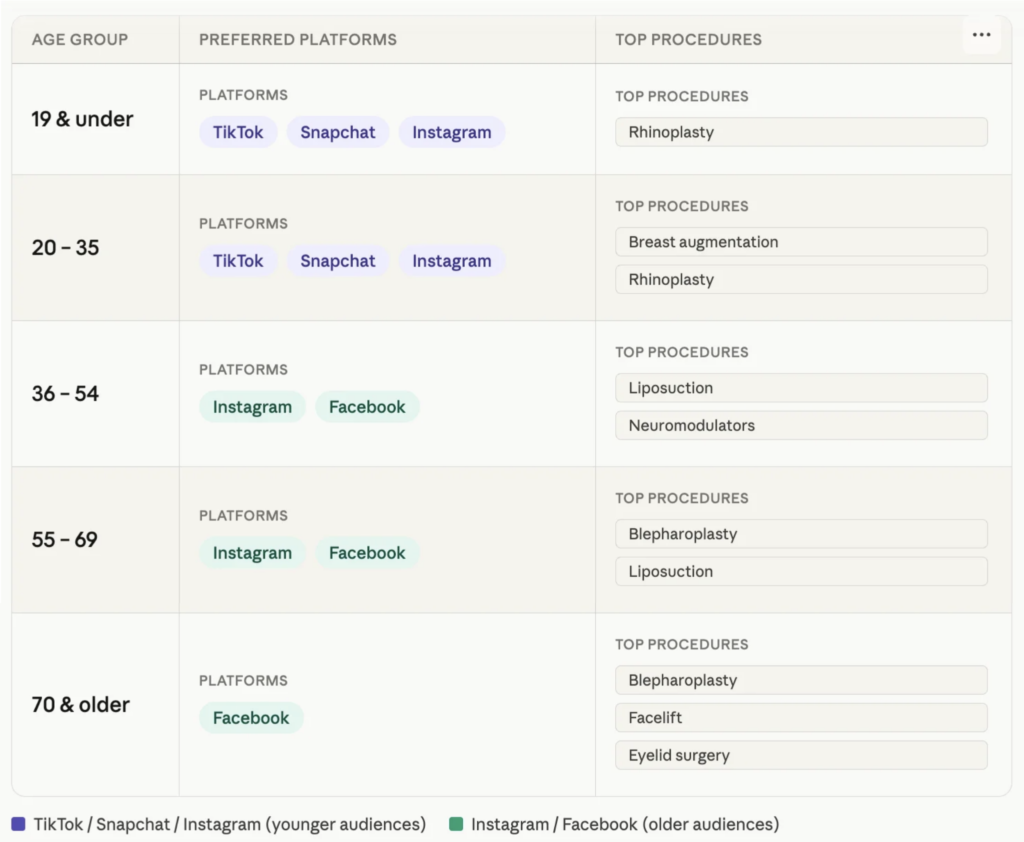
Additionally, overall 2024 statistics from the American Society of Plastic Surgeons** found that rhinoplasty was the most commonly performed surgical procedure for users 19 years and younger, and breast augmentation was especially sought after by those aged 20 – 39. The 40 – 54 age range frequently pursue liposuction and non-surgical neuromodulator injections, while those between the ages of 55 – 69 often opt for blepharoplasty. For patients aged 70 and older, facelift and eyelid surgery are some of the most popular surgeries.
In the aforementioned review from The Aesthetic Surgery Journal, studies found that all users — regardless of demographic — tend to engage more with aesthetic content rather than scientific content. This is a significant finding because it highlights the notion that, while informational, long-winded scientific studies and medical articles filled with complicated jargon are less likely to resonate with plastic surgery audiences across all age groups.
**Plastic Surgery Statistics 2024
TikTok

As it stands today, TikTok is the fastest growing social media app for plastic surgery marketing by far. This platform is exclusively designed for creating and sharing video content, allowing users to edit their videos with filters, effects, audio files, and other tools completely built into the app. Videos are usually 10 to 60 seconds long, mirroring trends in Internet culture that focus on easily digestible short-form content.
TikTok is one of the most effective, if not the most powerful, platform for far-reaching engagement and “going viral.” This is owed to its unique algorithm, which pushes new content to both followers and non-followers alike. Unlike Instagram and Facebook’s model of showing a user’s posts to only 15–20 percent of his/her/their followers first (and subsequently sharing the content further based on likes, comments, and engagement), TikTok creates the opportunity for unlimited growth by making content visible to a larger subsection than a person’s immediate followers. What’s more, TikTok offers a customized “For You” page that displays posts without requiring you to follow the creator’s account, and does not require you to have a TikTok account to view content. Even if your target demographic is not under 30 years old, TikTok can be a great place to stay up-to-date with trending topics, grow your practice’s online presence, and remain attuned to the larger plastic surgery conversation.
What works best on TikTok for plastic surgeons?
- Transformation videos: Quick before-and-after reveals resonate strongly with viewers.
- Educational myth-busting: Short clips debunking common misconceptions about surgery (e.g., recovery time, pain levels) establish credibility.
- Behind-the-scenes content: Showing the human side of your practice — staff interactions, treatment prep, or patient journeys (with consent).
- Trending formats: Using popular sounds, challenges, or duet reactions to tap into current trends.
Pro tip: TikTok has recently limited the number of hashtags per post and tightened restrictions on medical content, so using precise, compliant language and approved hashtags is crucial. With the #PlasticSurgery hashtag already surpassing 16 billion views, creative and ethical posting can help you reach millions of potential patients.
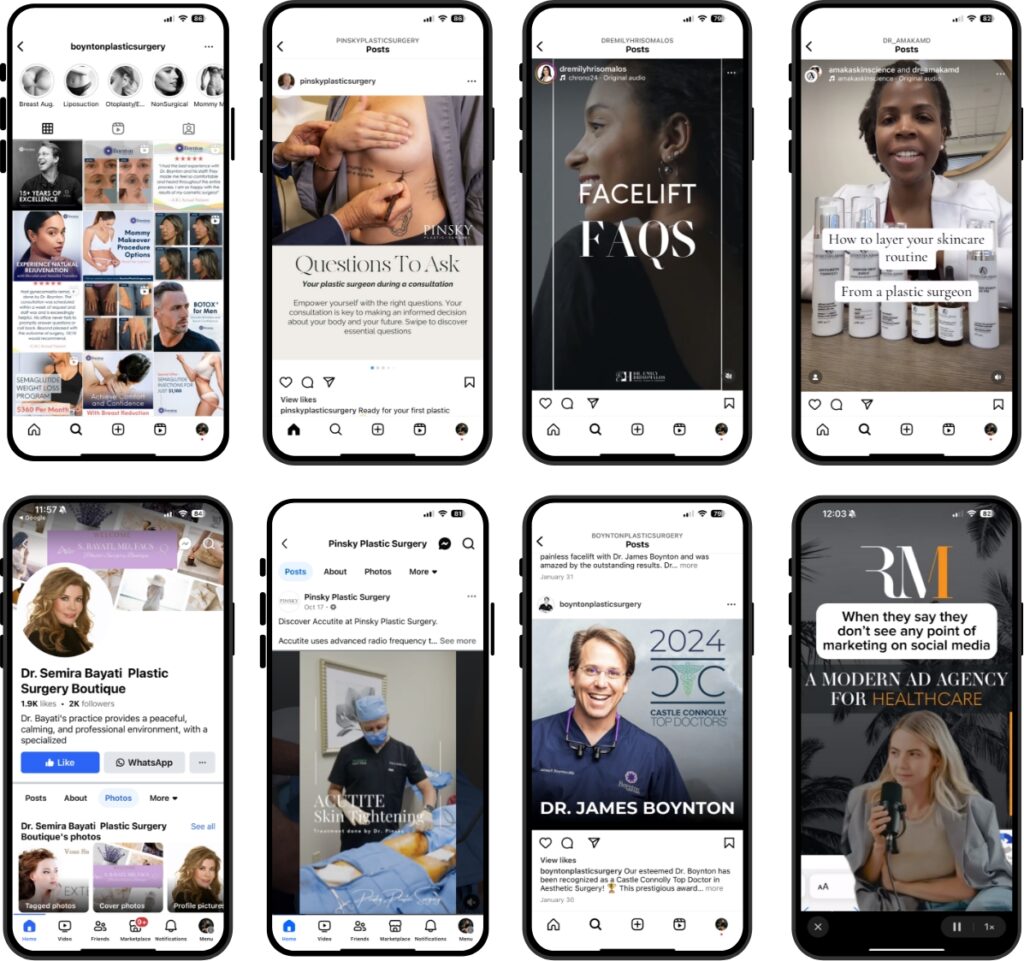
Instagram can provide an excellent opportunity to post photo and video content, while offering a solid platform to run promotions and specials campaigns. Most popularly used among patients between ages 25 and 34, Instagram can be successful with a variety of content ideas.
What works best on Instagram for plastic surgeons?
- Before-and-after photos (with patient consent) to showcase results.
- Testimonials to build trust and credibility.
- Patient education on treatments and recovery tips.
- Behind-the-scenes practice content that spotlight staff, celebrations, or “day in the life” clips.
With the proliferation of Instagram Reels — short-form videos that can serve as storytelling, ads, or opportunities for brand discovery — plastic surgeons have more tools than ever to showcase their practice, sell an experience, highlight results, and more. Reels can also function as advertisements for a product, treatment, or promotional campaign, similar to how the “Swipe Up” function in a company’s Stories can drive website traffic and help provide insight on engagement.
Instagram also now shows up in Google search results, boosting visibility beyond the app itself. That means well-optimized captions, alt text, and strategic hashtags can support your plastic surgery search engine optimization (SEO) while building social engagement.

As the longest-standing social media platform to date, Facebook is where older patients aged 45 to 54 are more likely to frequent. Unlike TikTok and Instagram, which are more visually and trend-driven, Facebook users often engage with longer content formats and community-based interactions.
Best uses of Facebook for plastic surgeons include:
- Event promotions (open houses, webinars, live Q&As)
- Special offers and seasonal campaigns
- Blog shares to drive website traffic and SEO signals
- Facebook Groups that foster community around recovery journeys, skincare tips, or cosmetic enhancement discussions
Since patients in their 30s and 40s are more likely to consider a surgical procedure over non-surgical treatments, posting cosmetic surgery information on Facebook can be a strong way to target the platform’s user base. Paid Facebook ads also offer highly refined targeting options, allowing practices to reach potential patients by location, age, interests, and even browsing behavior.
Additional Platforms
While TikTok, Instagram, and Facebook are the most popular social media platforms for plastic surgery marketing, there are additional platforms that practices can utilize.
YouTube

Plastic surgery practices can use YouTube by posting educational content that explains procedures, answers common questions, and showcases patient testimonials and before-and-after transformations (as long as the patient has provided permission). Other ideas include behind-the-scenes tours of practice facilities and interviews with staff to build trust and transparency. These can help enhance the practice’s visibility, demonstrate expertise, and attract potential patients by providing valuable insights into available services.

Practices can leverage LinkedIn by sharing articles and posts about the latest procedures and industry trends. Plastic surgeons can engage with other professionals by participating in discussions and sharing insights, which helps build a reputable brand image. LinkedIn ads also allow targeting specific demographics, making it an effective platform for professional networking and direct marketing.
While not as widely discussed as TikTok or Instagram, Pinterest can be a powerful discovery platform for patients planning cosmetic procedures. Users often create boards for “wedding prep,” “mommy makeover goals,” or “anti-aging solutions,” making it an excellent place to showcase before-and-after galleries, infographics, and blog graphics. Since Pinterest is also indexed by Google, optimizing pins with procedure-specific keywords (e.g., “rhinoplasty recovery timeline,” “liposuction results”) can help extend your practice’s search presence.
Threads and Emerging Platforms
New platforms like Threads (Meta’s answer to X/Twitter) are quickly becoming spaces for professional voices to share insights and join trending conversations. While Threads is still growing, early adopters in the plastic surgery field can establish thought leadership by posting quick tips, commenting on industry trends, and engaging with patients in real time. Monitoring and experimenting with emerging platforms positions your practice ahead of the curve.
Content Calendar and Posting Cadence
Knowing which platforms to use is only half the equation. The practices that consistently see results from social media aren’t necessarily the ones with the biggest budgets or the most followers, but the ones that show up reliably, with content that feels intentional rather than improvised. That consistency starts with a content calendar.
Why a Content Calendar Matters
Posting reactively, such as when someone remembers to, or when a slow afternoon opens up, almost always results in long gaps in activity, redundant content themes, and missed opportunities to align posts with seasonal demand or promotional campaigns. A content calendar can solve these problems at once. It distributes the creative work across the month instead of concentrating it into stressful last-minute sessions, ensures a healthy mix of content types and topics, and makes it far easier to spot gaps before they happen rather than after.
It also makes delegation possible. Whether you’re working with an in-house coordinator, a social media agency, or a part-time marketing assistant, a shared calendar gives everyone visibility into what’s planned, what’s needed, and what’s already approved.
Recommended Posting Cadence by Platform
Every platform has its own algorithm logic, and understanding that logic informs how often and when you should post.
TikTok rewards volume and consistency more than any other platform. The algorithm actively tests new content with a broad audience, which means more posts create more opportunities for discovery. For practices that are actively building their TikTok presence, a cadence of four to six posts per week is ideal. Quality matters, but on TikTok, a genuine, conversational 30-second video filmed on a smartphone will frequently outperform a heavily produced piece. Aim for a mix of educational myth-busting, before-and-after reveals (with patient consent), and behind-the-scenes moments. Batch filming, which is dedicating two to three hours one afternoon to record a week’s worth of short videos, is generally the most practical way to maintain this frequency without it consuming your workday.
Instagram typically performs best with a cadence of four to five posts per week across its formats: a mix of feed posts (photos and carousels), Stories, and Reels. Feed posts and Reels tend to have longer shelf lives in the algorithm and are worth more production investment, while Stories can be ideal for time-sensitive content like limited promotions, same-day availability, or quick Q&A sessions. The Reels algorithm behaves similarly to TikTok in that it surfaces content to non-followers, so treating Reels as a discovery tool and feed posts as your permanent portfolio is a useful mental model.
Facebook is often best served by two to four posts per week. Unlike TikTok and Instagram, where frequency drives algorithm performance, Facebook rewards engagement, particularly from Groups and event-based content. Prioritize posts that invite interaction: questions, polls, patient stories, and event announcements for open houses or webinars. Sharing blog content from your practice website can also be an effective Facebook strategy, both for driving traffic and for signaling topical relevance to Google.
YouTube operates on an entirely different rhythm. A cadence of one to two videos per month is typically sufficient for most practices, because YouTube functions more like a search engine than a social feed. In most cases, well-optimized videos continue attracting views for years after they’re published. Focus on topics patients actively search for: procedure explainers, recovery timelines, “what to expect” guides, and FAQ-format videos.
Pinterest requires an initial investment of populating your boards, so plan for 10 to 15 optimized pins per week for the first two to three months. After that, a maintenance cadence of four to six pins per week keeps your account active in the algorithm. The content does most of its work over time through search, so patience is key.
Building a 30-Day Content Mix
A healthy monthly content calendar for a practice running Instagram and Facebook as primary channels might look something like this:
- Roughly a third of your posts should be educational content, including procedure explainers, myth-busting posts, recovery tips, or answers to frequently asked questions. This content helps build credibility and keeps patients engaged between consultations.
- Another third should be social proof content, such as before-and-after galleries (with written patient consent), testimonials, and patient stories. This is the content most likely to drive consultation inquiries, because it gives prospective patients a concrete, relatable sense of what results are possible.
- The remaining third is practice personality content, so staff spotlights, behind-the-scenes moments, celebrations, community involvement, and the occasional promotional post. This content can build the trust and familiarity that makes a potential patient choose your practice over a competitor they found in the same search.
- Promotional content, including sale announcements, seasonal specials, and event invitations, should make up no more than 10 to 15 percent of your total posts. Feeds that skew too heavily promotional tend to see lower organic engagement and can feel transactional to the followers you’re trying to build a relationship with.
Seasonal Planning and High-Opportunity Periods
Plastic surgery has natural peaks in patient interest that a content calendar should reflect. The period from late October through December is historically one of the busiest for non-surgical treatments, as patients want to look their best for the holidays. January through March sees increased interest in body contouring procedures as patients begin thinking about spring and summer. The weeks leading up to major holidays, such as Valentine’s Day, Mother’s Day, and New Year’s, are consistent high-interest periods for both surgical consultations and non-surgical treatments.
Planning ahead for these windows means your educational and awareness content lands in the weeks before patient intent peaks, not after. A post about the recovery timeline for a mommy makeover published in late November can plant the seed for a January consultation. A series on non-surgical facial rejuvenation published in early December positions your practice exactly when patients are beginning to think about how they want to look at holiday gatherings.
Building these seasonal moments into your calendar three to four months in advance — rather than scrambling to create reactive content when the moment arrives — is one of the simplest and highest-impact habits you can develop as a practice marketing to cosmetic surgery patients.
Compliance and Ethical Considerations
With social media influencing patient decisions more than ever, it’s vital for plastic surgeons to maintain professionalism and compliance online. Best practices include:
- Securing written consent before sharing patient images or testimonials.
- Avoiding exaggerated claims or misleading “miracle” transformations.
- Providing context for before-and-after photos (e.g., timeline for healing).
- Balancing education with engagement by keeping posts approachable without sacrificing accuracy.
By adhering to these guidelines, practices can build trust while standing out in a crowded digital space.
Feeling Overwhelmed? Let RM Be Your Guide
Plastic surgery audiences engage with a broad range of social media platforms, and more social apps are being created every day. With the ever-increasing influence of social media on cosmetic surgery and aesthetic medicine, we know that delivering top-notch content on every platform can feel like a full time job. At Rosemont Media, our creative professionals can help you navigate your social marketing and SEO needs to multiply engagement, gain leads, and stay competitive in your marketplace. Get tips from our agency and reach out to Rosemont Media today!
Editor’s note: The original version of this post was published on 11/14/2023.