Local SEO for Plastic Surgeons: A Guide to Ranking Higher in Search
Key Points
- Maximizing local SEO for plastic surgeons means optimizing your online presence, including your Google Business Profile (GBP), website, reviews, and citations. This allows local patients who are searching for your services to find your practice first rather than competing for broad, non-local search traffic.
- A fully optimized Google Business Profile, consistent NAP data across every touchpoint, and a fast, mobile-friendly site remain the foundation for ranking in Google’s top-3 map results.
- As more patients ask AI systems like ChatGPT, Gemini, and Perplexity directly for provider recommendations, ranking well in the traditional Local Pack no longer guarantees visibility in an AI Overview or AI-generated answer. Each platform weighs different signals and sources.
- Plastic surgeons should optimize their website and online presence so they’re easily crawled by AI tools to remain visible in generative answers and recommendations.
- Patient reviews aren’t just a ranking factor for Google. On AI platforms, ratings often act as a hard cutoff and practices below a certain star average or review volume risk being excluded from AI recommendations entirely.
- Hyperlocal landing pages, neighborhood-specific content, and localized blogging give practices more opportunities to capture specific, high-intent searches.
- Schema markup (LocalBusiness, MedicalProcedure, FAQPage, Review) helps traditional search engines and AI systems alike interpret and accurately surface a practice’s services, making it one of the highest-leverage technical investments for both classic and AI-driven local search.
- Local SEO Landscape for Plastic Surgeons
- GBP Optimization
- NAP Consistency
- Mobile Search Optimization
- Maintain Patient Reviews
- Other Local Reputation Signals
- Integrating Local Keywords
- Optimizing for Conversational Search
- Local Visibility in AI Search
- Hyperlocal Landing Pages
- Localized Blogging & News Content
- Integrating Local Backlinks
- Technical SEO
- Leveraging Structured Data
- Social Media Engagement
- Taking Advantage of Local Posts
- Optimizing for Patient Conversion
- Competitive Local SERP Analysis
- Tracking Local SEO
- Future Trends
- Contact the RM Team
Understanding the Local SEO Landscape for Plastic Surgeons
Before diving into tactics, it’s essential to grasp why local SEO is different from traditional SEO. While general SEO is about reaching broad audiences, local SEO targets prospective patients in your geographic area, typically those ready to book consultations. Google’s Local Pack—those top 3 map results—drives high-converting traffic. For plastic surgeons, where trust and proximity are paramount, ranking in the Local Pack is gold.
Think of Local SEO as the digital version of your office signage—except it reaches patients before they even leave their homes. When you utilize Google to search for a service in your general area, you’ve likely seen a section called “Places” instantly appear at or near the top of the first results page that contains the names of three businesses or organizations. Otherwise known as the “Local Pack,” these listings appear side-by-side with a Google map. Placement in the Local Pack can make your practice remarkably visible, and there are things you can do to improve the likelihood of inclusion in that distinct and prominent group.
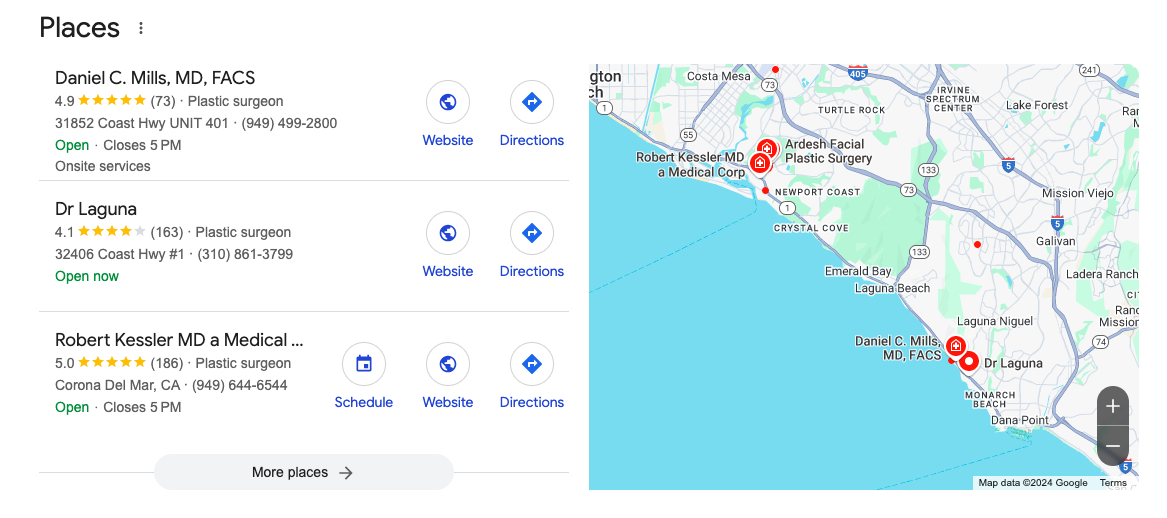
In addition to our guide on SEO for plastic surgeons, which goes right along with enhancing local SEO strategies, here are some tips on best practices that may just help you become the leader of the Local Pack:
GBP (Google Business Profile) Optimization
Creating a Google Business Profile is one of the most important things you can do to increase the chances of entry into the Local Pack. Once you click on one of the top three businesses in the Local Pack, the GBP should pop up on the righthand side. The GBP offers an array of helpful details about the practice. Make sure your GBP is optimized carefully and precisely because accurate information is key. Ensure that the URL for your website, as well as the name of your practice, address, and phone number, are all correctly listed on all of your online platforms. Also, the services your practice offers should be clearly listed and placed in relevant categories. Finally, it is often a good idea to enhance your GBP with high-quality video and/or images of yourself, your practice, and your team.
Most practices claim their Google Business Profile (GBP), but few optimize it fully. Go beyond the basics:
- Service Categories: Add subcategories for specific procedures (e.g., “Facelift Surgeon,” “Breast Augmentation”).
- Procedure Descriptions: Use all available characters to describe your services clearly and keyword-rich.
- Q&A Section: Seed the FAQ with real patient questions and answers.
- Appointment Links: Integrate booking tools or link to your consultation page.
- Photo Strategy: Add before-and-after photos labeled with EXIF data (e.g., “San Diego Facelift Before-After.jpg”).
Maintain Consistency with Your Name, Address, and Phone Number (NAP)
This goes along with consistently ensuring accuracy of information in your Google Business Profile. Your NAP (Name, Address, and Phone number) should always be updated and correct basically everywhere you appear online, including your plastic surgery website, online directories, and social media pages. If your name, address, and phone number are not the same from one online platform to the other, Google may get confused and your ranking may be negatively affected as a result.
Mobile Search Optimization
Since many (if not most) people conduct local searches on their mobile phones these days, it’s very important to have a website that is designed to load quickly and to be easily viewed in full on mobile devices. This makes it a more pleasant experience for the person searching for local services and may ultimately aid your entrance into the Local Pack.
Maintain Patient Reviews
Google Maps takes positive reviews into account. Patient reviews can boost online reputation management for plastic surgeons and they can be a major factor for placement in the Local Pack. By encouraging satisfied patients to write reviews about your practice and by quickly responding to them, you can clearly emphasize your dedication to providing your patients with the best possible experience. Google reviews are a ranking factor and trust signal. Quantity, frequency, and keyword usage within reviews matter.
Strategies:
- Respond to all reviews within 24–48 hours to show responsiveness and improve engagement; however, responses should be generic to avoid revealing they are a patient, which procedure was performed, or other protected health information. “Thank you for your kind words” is an example of an acceptable response.
- Use post-op follow-ups to request reviews.
- Direct satisfied patients to your GBP using QR codes in-office.
- Don’t review-gate—Google frowns on it.
Local Reputation Signals Beyond Google Reviews
While Google reviews are essential, they are only one piece of the local trust puzzle. Search engines evaluate reputation across a broader ecosystem that includes third-party medical platforms, local directories, and brand mentions without links.
Profiles on sites such as RealSelf, Healthgrades, Vitals, and local business associations contribute to perceived authority and credibility. Consistent branding, accurate NAP details, and active engagement on these platforms can reinforce your legitimacy as a trusted local provider.
Unlinked brand mentions, such as being cited in local news articles, podcasts, or community blogs, also matter. Even without a clickable backlink, these references signal prominence and relevance. Monitoring brand mentions for medical practices and ensuring accuracy across the web can quietly strengthen your local SEO foundation over time.
Integration of Local Keywords in Your SEO Strategy
The overall custom SEO strategy for plastic surgeons should be leveraged to enhance visibility in the Local Pack by incorporating geo-targeted keywords—such as “plastic surgery in San Diego” or “San Diego plastic surgeon”—across the main website pages and blog content. Don’t stop at just your city; include nearby neighborhoods or suburbs patients might search from to widen your local reach. Key strategies include creating city + procedure pages like “Rhinoplasty in La Jolla” or “Breast Lift in Del Mar,” optimizing doctor bios with local affiliations and references, and applying LocalBusiness schema markup on every service location page. For example, a well-structured page for “Tummy Tuck in La Jolla” could feature a patient testimonial, a brief case study, and directions from recognizable local landmarks.
Optimizing for “Near Me” and Conversational Search Queries
Search behavior continues to evolve toward more conversational, intent-driven queries, especially on mobile and voice-enabled devices. Phrases like “best plastic surgeon near me,” “who does rhinoplasty nearby,” or “top facelift doctor close to me” rely heavily on proximity, relevance, and authority signals.
To capture this traffic, content should naturally incorporate conversational language and intent-based phrasing. FAQ sections, blog posts, and Google Business Profile Q&A entries are ideal places to address these queries directly. Rather than forcing exact-match keywords, focus on answering real patient questions clearly and locally.
Additionally, ensuring your practice address, service areas, and driving directions are easily accessible helps Google confidently match your practice to “near me” searches. Strong mobile usability and fast load times further increase your chances of appearing when and where these searches happen.
Local Visibility in AI Search & LLMs
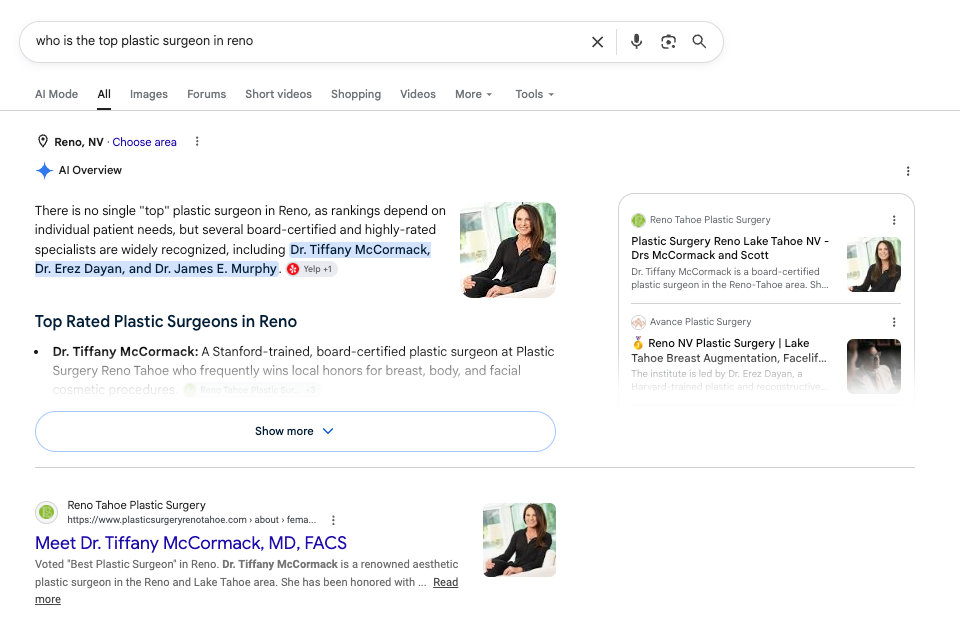
As more online users ask AI-powered platforms questions like, “Who is the top breast augmentation surgeon in Reno?” rather than typing “breast augmentation surgeon near me,” it’s important to understand the behavioral shifts in how people search for local services in 2026.
A growing share of prospective patients now ask ChatGPT, Claude, Gemini, Perplexity, and other AI assistants to recommend a reputable plastic surgeon rather than using Google to shop for providers. This highlights a distinct change in how Google recommends local businesses — rather than giving users a menu of links to explore based on proximity, relevance, and prominence, Google is now attempting to answer questions directly based on trust signals and AI interpretation. In fact, Google’s AI Overview pack is now overtaking the classic Google 3-pack for many local searches.
Surfacing for AI Queries
Crucially, appearing in Google’s Local Pack doesn’t guarantee you’ll be mentioned when an AI assistant answers the same question. This means a plastic surgery practice can dominate the Google Local Pack and still be invisible in an AI Overview, ChatGPT, or Perplexity answer since these tools pull from a different mix of signals and sources than Google Maps.
Important considerations:
- Reviews present a visibility threshold: For many LLMs, once a practice’s average rating drops below 4 stars, AI tools tend to exclude it from recommendations entirely rather than simply ranking it lower¹. Emerging data also suggests a review-volume threshold wherein practices with well over 100 reviews are cited far more consistently than those with only a handful of entries, even if the ratings are similar.
- AI tools assess your website rather than directly “seeing” your Google reviews: Many LLMs build their answers from crawled web content rather than live Google Maps data. Publishing real patient testimonials as visible, readable text on your own site — not just as an embedded rating badge — gives AI crawlers something to actually index and cite.
- Each AI engine behaves differently: For example, ChatGPT may lean on well-established, broadly consistent sources, whereas Perplexity favors newer, clearly-cited content.
As AI Overviews now appear on an increasing number of local-intent searches, understand that surfacing in these AI summaries is separate from ranking well in organic search results.
Strategies to adapt:
- Treat your website, not just your Google Business Profile, as the primary source AI tools will crawl. Keep procedure descriptions, credentials, and testimonials as real text, not just images or embedded widgets.
- Keep pushing review volume and response rate. Below a certain star and volume threshold, the possibility of AI recommendation is weaker.
- Periodically ask AI systems like ChatGPT and Perplexity the same questions a prospective patient would (e.g. “best facelift surgeon in San Diego”) and see whether your practice shows up. Treat this the way you’d check for presence in the Google Local Pack.
- Make sure NAP details, credentials, and affiliations are stated identically across your site, GBP, and major directories. Inconsistency undermines AI confidence the same way it undermines Google’s.
Hyperlocal Landing Pages: Going Beyond City-Level Optimization
Many plastic surgery practices stop at city-based optimization, but hyperlocal landing pages can dramatically expand your visibility within competitive metro areas. Instead of relying solely on a single “Plastic Surgeon in [City]” page, consider creating neighborhood- or district-specific pages that reflect how patients actually search.
For example, patients may search “plastic surgeon near Buckhead,” “cosmetic surgery Beverly Hills,” or “rhinoplasty Upper East Side.” These searches indicate strong intent and proximity. Hyperlocal pages should include tailored messaging, references to nearby landmarks, parking or accessibility details, and procedure-specific content relevant to that micro-area.
To avoid thin or duplicate content, each page should offer unique value, such as patient demographics, commonly requested procedures in that area, or travel considerations. Embedding a Google Map, localized testimonials, and internal links to core procedure pages further strengthens relevance and user experience. Over time, these pages can increase the chances of collectively dominating local SERPs and feeding authority back to your main location pages.
Localized Blogging & News Content
Too many plastic surgeons miss the chance to blog about hyperlocal topics. Instead of “Benefits of a Facelift,” try:
- “What La Jolla Patients Should Know Before Getting a Facelift”
- “Top Plastic Surgery Trends in San Diego – 2025 Edition”
- “How Coastal Weather Affects Skin Treatments”
Also include press releases about awards, media mentions, or new hires, with location-specific headlines and schema.
Integration of Local Backlinks
Links from other websites that direct the viewer to pages on your own website are called backlinks. These can be very helpful, especially when they come from directories, organizations, and websites that are local to your area. This can help Google determine that your business is trusted in the community.
A strong backlink profile remains a top ranking factor.
Tactics:
- Partner with local wellness influencers or med spas for reciprocal blog posts.
- Submit articles or op-eds to local lifestyle magazines.
- Sponsor community events and request backlinks on event sites.
Think of backlinks as digital referrals. The more respected locals vouch for you, the better Google trusts your site.
Technical SEO & Core Web Vitals for Local Ranking
A fast-loading, mobile-friendly plastic surgery website impacts local rankings.
- Compress images, especially on procedure galleries.
- Implement lazy loading for videos and heavy content.
- Ensure your location pages are indexable and not buried in navigation.
- Set up breadcrumb navigation and internal links between related services and locations.
Run your site through PageSpeed Insights and address mobile performance issues—it can mean the difference between ranking #3 and falling off the pack.
Leveraging Structured Data for Enhanced Local Visibility
Structured data (schema markup) helps search engines interpret your practice’s content more accurately and can increase eligibility for enhanced search features. While many plastic surgery websites implement basic LocalBusiness schema, more advanced schema types are often overlooked, and that’s where meaningful competitive advantages can be found.
Key structured data opportunities for plastic surgeons include:
- LocalBusiness & Physician Schema
Clearly defines your practice name, location, contact information, credentials, and affiliations, which can reinforce trust and geographic relevance. - MedicalProcedure Schema
Helps search engines understand specific treatments offered (e.g., facelift, rhinoplasty, breast augmentation), including anatomy focus and procedure type. - FAQPage Schema
Allows frequently asked questions to appear directly in search results, increasing visibility and click-through rates for local queries. - Review & AggregateRating Schema
Enhances credibility signals by associating verified patient feedback with your practice and services. - Service-Area Markup
Clarifies which cities, neighborhoods, or regions you serve, which can be especially helpful for “near me” and hyperlocal searches.
As Google continues rolling out AI-generated summaries and richer local results, structured data becomes even more important. This evolution aligns closely with GEO (Generative Engine Optimization). GEO for plastic surgeons focuses on visibility for plastic surgery practices within AI-powered search experiences. Those that proactively define their services, expertise, and location through schema are better positioned to be surfaced accurately—and prominently—in both traditional and AI-driven local search results.
Social Media Engagement
Social media engagement is a big contributing factor for local SEO strategies. It doesn’t have a direct effect on entrance into the Local Pack, but it can certainly have an indirect one by enhancing local SEO efforts and keeping your target audience engaged. Maintain a strong plastic surgery social media presence by regularly updating your platforms, remaining in touch with your followers, and providing links to your website on your social media channels.
Take Advantage of Google Posts
It’s a good idea to regularly update Google Posts, which is a nice feature of Google Business Profiles that helps keep them active. Google Posts can include quick updates about new offers and events from your practice, as well as information about top products, any recent honors or recognitions, and general announcements. In addition to text, Google Posts can include photos and videos.
Conversion Optimization for Local SEO Pages
Strong local rankings are only valuable if they translate into consultations. Local SEO pages should be designed not just to rank, but to convert high-intent visitors into real patient inquiries. This is where the best plastic surgery website design strategies play a critical role in turning rankings into real consultations.
High-performing local pages typically include:
- Clear, Visible Calls to Action
“Schedule a Consultation,” “Request a Virtual Visit,” or “Call Our Office” should appear above the fold and throughout the page. - Immediate Trust Signals
Board certification, years of experience, awards, hospital affiliations, and media mentions should be easy to find at a glance. - Localized Social Proof
Testimonials from nearby patients, location-specific reviews, or brief case highlights tied to the community can help build instant credibility. - Human-Centered Visuals
Authentic photos of the surgeon, team, and office environment can help visitors feel comfortable and confident in taking the next step. - Mobile-Friendly Contact Options
Click-to-call buttons, short forms, and fast-loading pages are essential for converting mobile local search traffic.
When conversion elements are intentionally layered into local SEO pages, rankings can turn into revenue. The goal is a page that not only attracts nearby patients, but actively guides them toward booking a consultation.
Competitive Local SERP Analysis: Know Your Real Rivals
Local SEO competition often looks different from traditional organic competition. Your real competitors may not be the most famous surgeons in your city, but those consistently appearing in the Local Pack for your highest-value procedures.
Regularly analyze Local Pack results for terms like “facelift [city],” “rhinoplasty near me,” or “breast augmentation [neighborhood].” Take note of recurring practices and evaluate their Google Business Profiles, review strategies, service listings, and content depth.
Understanding what top-ranking competitors are doing well—and where they fall short—can reveal opportunities for differentiation. Whether it’s more comprehensive procedure descriptions, better local content, or stronger engagement, informed adjustments based on real SERP data can help move your practice ahead strategically rather than reactively.
Tracking Local SEO Success: Metrics That Matter
Google Analytics and Search Console help, but also track:
- GBP Insights: phone calls, directions requests, photo views.
- Keyword rankings for “procedure + city” terms.
- Conversion rates on local pages.
- Review growth velocity.
Set KPIs for local leads and compare month-over-month. Tools like BrightLocal or Whitespark can help visualize local rankings.
Future Trends: AI & Local Search for Plastic Surgery
With Google leaning into AI-generated summaries and featured answers, expect more zero-click searches. To stay visible:
- Use structured data aggressively.
- Answer local questions in blog posts and GBP Q&A.
- Monitor changes in the Local Pack (e.g., the addition of Services buttons, menus, or AI cards).
Early adopters of AI-driven SEO and Google’s evolving display features will have the edge—especially when others sleep on it.
Conclusion
Local SEO isn’t a set-it-and-forget-it task—it’s a living extension of your practice’s reputation. For plastic surgeons in competitive markets, dominating the Local Pack can mean more qualified leads, booked consults, and brand trust that can’t be bought with ads alone. One of our experienced digital marketing consultants for medical practices will be happy to talk with you about custom strategies designed to help your practice stand out in a crowded online field.
Would you like to find out how you can increase your chances of inclusion in the Local Pack? Please contact Rosemont Media today.
Editor’s note: The original version of this post was published on 3/25/2025.